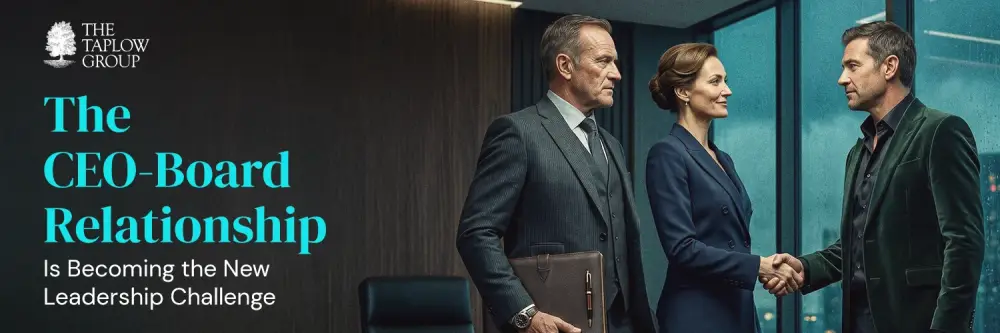
You don’t need to be a governance book to understand there's something different in the board room.
The amount of C-level reshuffles was the highest ever recorded in the last year, and plans for succession are accelerating, and the lines are becoming increasingly blurred between management and partnership.
The CEO-board relationship was a yearly quarterly chitchat that consisted of reports and resolutions, but is now one of the biggest business executive leadership problems of this decade.
Learn more about the leadership guide
The Shift from Oversight to Partnership
The simple idea of corporate governance for years has been that there are firstly the watchers, the board, and there are the doers, the CEOs. That model was indeed a back mirror and was helpful to see how much the company had moved forward, but not quite as helpful at determining what is next for the company.
Today, boards are expected to assume a “co-pilot” role, rather than a general counselor for the company chief and his administrative staff,
-
Get engaged in real time
-
Get involved earlier in succession and strategy
-
Expected to add value rather than simply approve it.
CEO and board alignment isn't a courtesy anymore. It's a precondition for board leadership that actually works.
Read more about the crisis management for ceos
Trust as a Strategic Asset
Boardroom trust does the heavy lifting. In a climate of trust, strategic decisions are made at the speed that the market needs them. You aren't prepared to present a final product; you're prepared to show some key early signals instead of a final set of explanations.
While it may seem obvious, the idea of trust comes from recent research from the NACD that redefines it as something accrued deliberately, through clarity of roles and effective communication, and not assumed because all are good-intentioned.
Put the governance team and engine into the wrong gear, and it will be difficult for your board to keep up with your high-speed CEO.
Holding Challenge and Support Together
Trust without tension is just comfort, and comfort rarely produces broad effectiveness.
The hardest part of board oversight is holding two postures simultaneously - challenging the CEO's thinking while still backing the CEO's authority.
Boards that only support become rubber stamps. Boards that only leadership challenges become obstacles a CEO has to manage around, rather than partners a CEO can lean on.
The boards are getting this right shift posture by decision, mentoring on one issue, pushing back hard on another, stepping back on a third.
Recommended Read : Leadership effectiveness
What Boards Now Look for in a CEO?
This is quietly rewriting what boards look for in CEO talent.
Strategic command and operational competence are table stakes now. What is harder to find, and increasingly decides who gets the top job, is the discipline behind board-facing CEO accountability:
-
Reading a board's risk appetite accurately
-
Translating complexity into boardroom clarity
-
Absorbing scrutiny without becoming defensive.
With most new CEOs stepping into the role for the first time, this capability can no longer be assumed. It has to be assessed before the appointment and developed deliberately afterward, because it shapes CEO performance as much as any operating metric does.
The Future of Boardroom Leadership
How the CEO and the board relate to each other will be created and looked at as a capability, rather than a natural fit.
Those groups that invest in it will do better at managing through the transition of leadership and in processing the impact of shocks and disasters than those organisations that continue to simply conduct governance as an annual process.
The companies getting this right aren't the ones with the most polished governance manual. They're the ones where the CEO and the board have built a relationship strong enough to survive disagreement and clear-eyed enough to act on what they learn from it.
In a leadership environment this volatile, that relationship has stopped being a soft factor. It is the strategy.