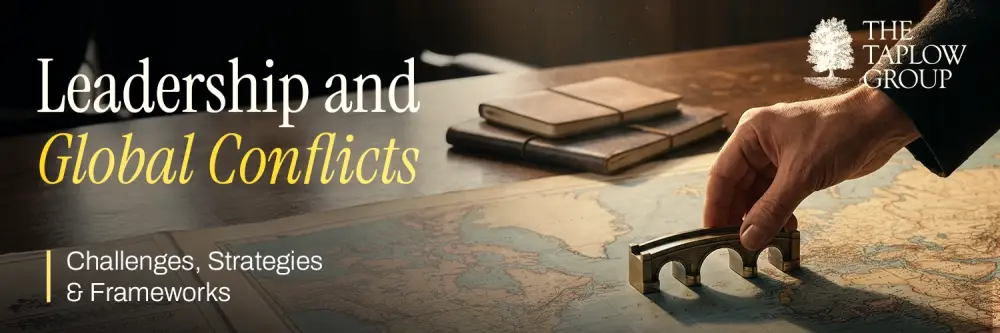
Global conflicts always crash on the leadership agenda.
Whether it's an ongoing war between the powerful nations or economic nationalism reshaping trade corridors, global conflicts walk right into the boardroom. They disrupt your supply chains. They unsettle your people. And they test every leadership instinct you have.
Here's the uncomfortable truth: the playbooks that got you to the C-suite, operational excellence, stakeholder management, and P&L ownership are necessary but not sufficient when the world is on fire. That's why the best executive search firms like us aren't just screening for business acumen.
At The Taplow Group, we see this shift every single day across our global client work.
Discover what leadership in a conflict-driven world truly demands, the challenges, the strategies, and a practical framework you can actually use.
Why are Global Conflicts a Leadership Priority?
Studies reveal that strategic leadership and risk management are the two most critical future competencies for resilience professionals precisely because global conflicts directly affect organisational stability.
It is irresponsible to overlook geopolitical conflict; it is not patriotism. The leaders that turn world instability into their background music are the ones who fall victims.
The Expanding Role of Leaders in a Conflict-Driven World
The roles of top-level leaders have been transformed radically. You're no longer just managing a business; you're managing meaning for your organisation. Your people want to know where the company stands. Your clients want assurance. Your investors want a strategy that survives disruption.
Leaders must:
-
Promote synergy, sympathy, and creativity.
-
Allowing their teams to succeed in the face of uncertainty.
-
Integrate foresight and profound human intellect.
Hire a global executive search firm to appoint and extend the position of your executives in international wars.
Key Leadership Challenges During Global Conflicts
The first step towards surmounting the leadership challenges that arise in the global conflict is to have an understanding of them. The four most urgent ones are the following:
-
Decision-Making Under Radical Uncertainty: The incomplete information, time-constrained situations, coupled with stakes, make a match-to-heaven, creating a perfect storm of bad decisions. The majority of leaders resort to the old patterns; conflicts require new frameworks.
-
Workforce Anxiety and Team Cohesion: Employees become affected when war erupts or when geopolitical fault lines are widened; this is particularly true for those employees who have families in the potential risk areas. Managers who reject this find a quick exit.
-
Ethical and Reputational Complexity: Do you exit a market under sanctions? Do you take a public stand? There is an ethical and reputational implication behind each decision.
-
Communication Breakdown: Such a situation of misinformation is hastened by conflict environments. Leaders who remain silent are perceived as accomplices or inconsiderate. Although it is difficult to utter words, it must be transparent.
Leadership Strategies to Navigate Global Conflicts
There are four strategies that are used by the most successful leaders at all times:
Scenario Planning Over Prediction
You cannot forecast the future crisis; however, you can create decision-ready situations. A couple of or three futures in war-gaming would force your leadership crew to think in possibilities, not probabilities.
Cross-Cultural & Geopolitical Intelligence
Strategic foresight and risk management, the ability to be flexible in decision-making and operating under difficult circumstances, cultural intelligence and cross-cultural leadership are the focus of studies. Local influences: Leaders who comprehend local power make quicker, smarter decisions.
Radical Transparency in Communication
The conflict-intelligent leaders are characterized by a special combination of self-awareness, emotional regulation, positive attitude towards conflicts, adaptability to strategy and savvy in communication. Your people do not need answer-perfects, they need honest answers.
Building Psychological Safety
Teams that feel safe to raise concerns, share bad news early, and challenge assumptions are far more resilient in crisis conditions.
And if your management consulting partner isn't helping you build these muscles into your leadership pipeline, it's time to ask why not.
Leadership Framework for Global Conflict Management
Most organisations react to global conflict. Those who emerge and succeed through it are those with a proactive framework.
The LEAD Model (A Strategic Approach to Global Conflict Leadership)
At The Taplow Group, we've synthesised our global experience and research into a practical four-step model: LEAD.
L (Learn and Understand the Geopolitical Landscape)
You have to understand first before you can answer. This implies investing in geopolitical intelligence, as opposed to headline reading, but with an emphasis on underlying causes and regional forces, as well as second-order impacts on your industry. When you do not comprehend why a conflict is taking place, you cannot guess the way it will develop.
E (Evaluate the Business Impact and Risks)
Map your exposure. Which markets are affected? Which suppliers sit within conflict zones? How vulnerable is your talent base? Clear decision-making that can be defended is provided by a thorough risk assessment. This is also where digital collaboration in the workplace becomes critical:
-
Real-time data
-
Cross-functional input
-
Distributed decision-making all depends on robust digital infrastructure
A (Act and Implement Strategic Responses)
Diversifying supply chains, turning on business continuity procedures, refocusing marketing strategy, or simply expressing an organisational position could be meant by this. It is strategic and not performative. A strategic decision must back any move.
D (Develop Long-Term Resilience)
The conflict will end or evolve into something else. Either anything you create in the crisis is your organisational capacity in the next crisis. Invest in leadership building, entrench scenario planning as a set of practices, and build your succession bench. Having resilience is not a project but an everlasting pose.
Closing Thoughts (The Taplow Group)
In our 44 offices and 21 countries, there is one thing that our consultants have learned: that conflict-prepared executives are not born but are made. and discovering them or making them takes more than intuition. It requires a rigorous, global approach to talent and leadership strategy.
Whether you need to identify crisis-tested executives through an executive search firm or deploy an interim executive search firm to place experienced leadership during a period of geopolitical disruption, The Taplow Group brings the expertise, network, and insight to get it right.
Because the world won't slow down, but with the right leaders in place, your organisation doesn't have to either.
Establish a conflict-resilient leadership within your organisation with the help of The Taplow Group.